


 Email Updates
Graduate medical education (GME) funds are entitlement-based, formula-driven reimbursements provided primarily by federal and state government programs, with significant contributions from private sources, to teaching institutions. GME funds are designed to cover the direct costs of medical education (such as resident stipends and faculty salaries) and the indirect costs associated with the increased resource use typical of a teaching environment (such as extra tests and staff time).
GME funds provide a potential funding mechanism to support the training of residents in integrated behavioral health, which can help practices offset staffing costs and build internal capacity.3 To access these funds, a primary care practice must have a formal, written agreement with an accredited, eligible residency program to be considered a non-hospital training site. Once the agreement is established, the teaching hospital or the sponsoring institution can count residents training at the practice for GME funding purposes.
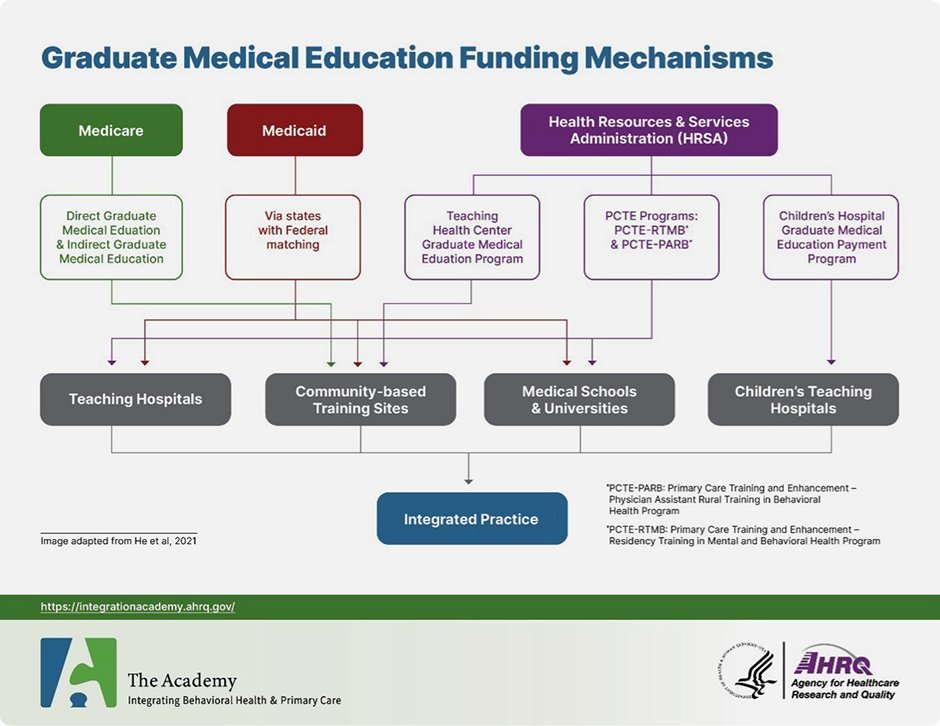

GME Funding Programs
- Medicare GME: Provides grant funding for resident stipends, salaries, and administrative costs in accredited programs, primarily for hospital-based sites, and supports residents in various specialties, including psychiatry. Learn more about Medicare GME.
- State Medicaid GME: Allows states to receive federal matching funds for hospital-based training costs, with flexibility to also fund community-based training for allopathic and osteopathic residents. Learn more about State Medicaid GME (PDF – 5 MB).
- Health Resources & Services Administration (HRSA)’s Teaching Health Center GME (THCGME) Program: Offers grant funding to support resident training in community-based ambulatory patient care centers, such as federally qualified health centers and rural health clinics, for residents in primary care specialties, including psychiatry. Learn more about the THCGME Program.
- HRSA’s Primary Care Training and Enhancement - Residency Training in Mental and Behavioral Health (PCTE-RTMB) Program: Provides grants to programs that train primary care residents to prevent, diagnose, and treat mental and behavioral health conditions. Learn more about the PCTE-RTMB Program.
- HRSA’s Primary Care Training and Enhancement - Physician Assistant Rural Training in Behavioral Health (PCTE-PARB) Program: Offers grant funding to develop clinical rotations in rural areas that integrate behavioral health services with primary care for physician assistant students. Learn more about the PCTE-PARB Program.
- HRSA’s Children’s Hospital GME Payment (CHGME) Program: Supports the education and training of residents at freestanding children's hospitals to enhance their ability to care for low-income patients, including pediatric residents and child and adolescent psychiatry fellows. Learn more about the CHGME Program.


1. Miller BF, Ross KM, Davis MM, Melek SP, Kathol R, Gordon P. Payment Reform in the Patient-Centered Medical Home: Enabling and Sustaining Integrated Behavioral Health Care. Am Psychol. 2017 Jan;72(1):55-68. doi:10.1037/a0040448 PubMed PMID: 28068138; PubMed Central PMCID: PMC7324070.
2. Grazier KL, Smiley ML, Bondalapati KS. Overcoming Barriers to Integrating Behavioral Health and Primary Care Services. J Prim Care Community Health. 2016 Oct 1;7(4):242-248. doi:10.1177/2150131916656455
3. Ma KPK, Mollis BL, Rolfes J, Au M, Crocker A, Scholle SH, et al. Payment strategies for behavioral health integration in hospital-affiliated and non-hospital-affiliated primary care practices. Transl Behav Med. 2022 Jul 26;12(8):878-883. doi:10.1093/tbm/ibac053 PubMed PMID: 35880768; PubMed Central PMCID: PMC9385119.
4. By. UNC Family Medicine Launches Primary Care Behavioral Health Collaborative at East Pittsboro, Advancing Whole-Person Care. Newsroom [Internet]. 2026 Jan 22 [cited 2026 Feb 18]. Available from: https://news.unchealthcare.org/2026/01/unc-family-medicine-launches-primary-care-behavioral-health-collaborative-at-east-pittsboro-advancing-whole-person-care/
5. Yabuki family donates $20 million to transform response to pediatric mental and behavioral health crisis [Internet]. [cited 2026 Feb 18]. Available from: https://childrenswi.org/at-every-turn/stories/2021/07/yabuki-donates-20-million-to-address-mental-health-crisis
6. Anschutz Foundation Supports Youth Mental Health with Generous Gift [Internet]. [cited 2026 Feb 18]. Available from: https://www.childrenscolorado.org/about/news/2025/september-2025/transformational-gift-for-mental-health-care/
7. Healing Hands Health - Bristol, TN [Internet]. [cited 2026 Feb 23]. Food City Presents $100,000 Check to Healing Hands Health in Support of Capital Campaign. Available from: https://www.healinghandshealth.org/press-releases/food-city-presents-100000-check-to-healing-hands-health-in-support-of-capital-campaign
8. Capital Campaign. Community Health Center of NRV [Internet]. [cited 2026 Feb 23]. Available from: https://chcnrv.org/capital-campaign/
9. St. John’s Health [Internet]. [cited 2026 Feb 18]. Capital Additions & Upgrades | St. John’s Health Foundation. Available from: https://www.stjohns.health/foundation/campaigns/behavioral-health-endowment/
10. Bodenheimer T, Sinsky C. From Triple to Quadruple Aim: Care of the Patient Requires Care of the Provider. Ann Fam Med. 2014 Nov;12(6):573-576. doi:10.1370/afm.1713 PubMed PMID: 25384822; PubMed Central PMCID: PMC4226781.
11. American Medical Association [Internet]. 2025 [cited 2026 Feb 2]. Medicare Basics series: Advancing value-based care with alternative payment models. Available from: https://www.ama-assn.org/practice-management/medicare-medicaid/medicare-basics-series-advancing-value-based-care-alternative
12. American Medical Association. Behavioral health opportunities in value-based care: Guidance for physician practices [Internet]. Washington, DC: American Medical Association; 2025 Aug [cited 2026 Feb 1]. Report No. Available from: https://www.ama-assn.org/system/files/behavioral-health-value-based-care.pdf
13. America’s Health Insurance Plans. Integrating Behavioral Health and Primary Care: Better Care and Health for the Whole Person [Internet]. Washington, DC: America’s Health Insurance Plans; 2022 Feb [cited 2025 Sep 12]. Report No. Available from: https://ahiporg-production.s3.amazonaws.com/documents/202202-AHIP_IB_Behavioral_Health_Integration-004.pdf
14. Marcotte LM, Reddy A, Zhou L, Razliff A, Unützer J, Chang D, et al. Provision of Collaborative Care Model and General Behavioral Health Integration Services in Medicare. Psychiatr Serv. 2021 Jul;72(7):822-825. doi:10.1176/appi.ps.202000265
15. Cross DA, Qin X, Huckfeldt P, Jarosek S, Parsons H, Golberstein E. Use of Medicare’s Behavioral Health Integration Service Codes in the First Two Years: an Observational Study. J Gen Intern Med. 2020 Dec;35(12):3745-3746. doi:10.1007/s11606-019-05579-2 PubMed PMID: 31845107; PubMed Central PMCID: PMC7728892.
16. Lombardi BM, Greeno C, de Saxe Zerden L. Examining the use of psychiatric collaborative care and behavioral health integration codes at federally qualified health centers: A mixed-methods study. Fam Syst Health. 2023;41(4):527-536. doi:10.1037/fsh0000827
17. Shmerling AC, Gold SB, Gilchrist EC, Miller BF. Integrating behavioral health and primary care: a qualitative analysis of financial barriers and solutions. Transl Behav Med. 2020 Aug 7;10(3):648-656. doi:10.1093/tbm/ibz026
18. Melissa Bailey, Rachael Matulis, Kelsey Brykman. Behavioral Health Provider Participation in Medicaid Value-Based Payment Models: An Environmental Scan and Policy Considerations [Internet]. Hamilton, NJ: Center for Health Care Strategies, Inc.; 2019 Sep [cited 2026 Feb 1]. Report No. Available from: https://www.chcs.org/media/behavioral-health-provider-participation-in-medicaid-value-based-payment-models-an-environmental-scan-and-policy-considerations.pdf
19. MBA RJ Kevin Dotson, Munzoor Shaikh. The key role of downside risk in the success of value-based care. HFMA [Internet]. 2024 Jun 2 [cited 2026 Feb 2]. Available from: https://www.hfma.org/payment-reimbursement-and-managed-care/value-based-payment/the-key-role-of-downside-risk-in-vbcs-success/
20. Soper MH, Matulis R, Menschner C. Moving Toward Value-Based Payment for Medicaid Behavioral Health Services [Internet]. Available from: https://njamha.org/links/boardmeetings/CHCSpaperonVBC.pdf
21. Ross KM, Gilchrist EC, Melek SP, Gordon PD, Ruland SL, Miller BF. Cost savings associated with an alternative payment model for integrating behavioral health in primary care. Transl Behav Med. 2019 Mar 1;9(2):274-281. doi:10.1093/tbm/iby054 PubMed PMID: 29796605.
22. An Analysis of DRG Profitability and Cross-Subsidization in Academic Medical Centers [Internet]. [cited 2026 Feb 2]. Available from: https://ajhcs.org/article/an-analysis-of-drg-profitability/
23. Gaffney LK, Michelson KA. Analysis of Hospital Operating Margins and Provision of Safety Net Services. JAMA Netw Open. 2023 Apr 18;6(4):e238785. doi:10.1001/jamanetworkopen.2023.8785
24. Why Primary Care Practitioners Aren’t Joining Value-Based Payment Models: Reasons and Potential Solutions [Internet]. 2024 [cited 2026 Feb 2]. Available from: https://www.commonwealthfund.org/publications/issue-briefs/2024/jul/why-primary-care-practitioners-arent-joining-value-based-payment doi:10.26099/2cxx-0z64