


 Email Updates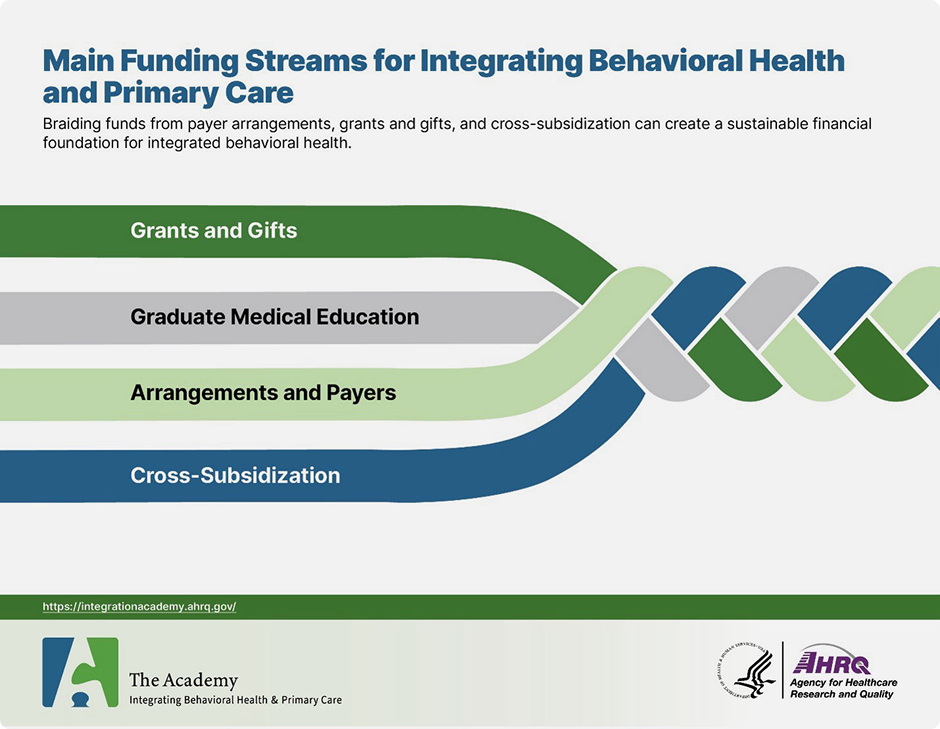

Potential Funding Streams for Behavioral Health Integration
Various grant funding opportunities and payer arrangements can support IBH.
Grant and Gifts
These funds can help cover start-up and other costs that payers do not reimburse.
Graduate Medical Education Funds
These funds can support the training of residents in IBH, helping offset staffing costs.
Arrangements with Payers
Payers may reimburse providers for each service provided (fee-for-service (FFS) payment) to patients or for achieving quality, outcomes, and cost metrics and targets (value-based payment).
Cross-subsidization
Revenue or savings generated in one service line can offset the costs or under- or non-reimbursed services in another.
How The Braided Model Can Work In Practice
These funding streams play different roles at various stages of your integration journey. They are not mutually exclusive; rather, their purpose shifts as your program matures.
- The Catalyst (Igniting the Model): In the early stages, grants, gifts, graduate medical education funds, and internal cross-subsidization serve as the spark. These streams pay for "un-billables"—such as technology upgrades, practice facilitation, and initial staff hires—that must be in place before you can successfully execute payer contracts.
- The Backbone (Generating the Baseline): As operations mature, payer arrangements (FFS and alternative payment models) become the primary stream, helping ensure the program remains viable after one-time grant funding expires. A large permanent endowment can also serve as a long-term funding anchor.
- The Stabilizer (Ensuring Longevity): Once the model is mature, cross-subsidization evolves into a stabilizer. You take payments earned under alternative payment models and reinvest them into the behavioral health providers of the care team to sustain their non-billable or unreimbursed clinical work.


1. Miller BF, Ross KM, Davis MM, Melek SP, Kathol R, Gordon P. Payment Reform in the Patient-Centered Medical Home: Enabling and Sustaining Integrated Behavioral Health Care. Am Psychol. 2017 Jan;72(1):55-68. doi:10.1037/a0040448 PubMed PMID: 28068138; PubMed Central PMCID: PMC7324070.
2. Grazier KL, Smiley ML, Bondalapati KS. Overcoming Barriers to Integrating Behavioral Health and Primary Care Services. J Prim Care Community Health. 2016 Oct 1;7(4):242-248. doi:10.1177/2150131916656455
3. Ma KPK, Mollis BL, Rolfes J, Au M, Crocker A, Scholle SH, et al. Payment strategies for behavioral health integration in hospital-affiliated and non-hospital-affiliated primary care practices. Transl Behav Med. 2022 Jul 26;12(8):878-883. doi:10.1093/tbm/ibac053 PubMed PMID: 35880768; PubMed Central PMCID: PMC9385119.
4. UNC Family Medicine Launches Primary Care Behavioral Health Collaborative at East Pittsboro, Advancing Whole-Person Care. Newsroom [Internet]. 2026 Jan 22 [cited 2026 Feb 18]. Available from: https://news.unchealthcare.org/2026/01/unc-family-medicine-launches-primary-care-behavioral-health-collaborative-at-east-pittsboro-advancing-whole-person-care/
5. Yabuki family donates $20 million to transform response to pediatric mental and behavioral health crisis [Internet]. [cited 2026 Feb 18]. Available from: https://childrenswi.org/at-every-turn/stories/2021/07/yabuki-donates-20-million-to-address-mental-health-crisis
6. Anschutz Foundation Supports Youth Mental Health with Generous Gift [Internet]. [cited 2026 Feb 18]. Available from: https://www.childrenscolorado.org/about/news/2025/september-2025/transformational-gift-for-mental-health-care/
7. Healing Hands Health - Bristol, TN [Internet]. [cited 2026 Feb 23]. Food City Presents $100,000 Check to Healing Hands Health in Support of Capital Campaign. Available from: https://www.healinghandshealth.org/press-releases/food-city-presents-100000-check-to-healing-hands-health-in-support-of-capital-campaign
8. Capital Campaign. Community Health Center of NRV [Internet]. [cited 2026 Feb 23]. Available from: https://chcnrv.org/capital-campaign/
9. St. John’s Health [Internet]. [cited 2026 Feb 18]. Capital Additions & Upgrades | St. John’s Health Foundation. Available from: https://www.stjohns.health/foundation/campaigns/behavioral-health-endowment/
10. Bodenheimer T, Sinsky C. From Triple to Quadruple Aim: Care of the Patient Requires Care of the Provider. Ann Fam Med. 2014 Nov;12(6):573-576. doi:10.1370/afm.1713 PubMed PMID: 25384822; PubMed Central PMCID: PMC4226781.
11. American Medical Association [Internet]. 2025 [cited 2026 Feb 2]. Medicare Basics Series: Advancing value-based care with alternative payment models. Available from: https://www.ama-assn.org/practice-management/medicare-medicaid/medicare-basics-series-advancing-value-based-care-alternative
12. American Medical Association. Behavioral health opportunities in value-based care: Guidance for physician practices [Internet]. Washington, DC: American Medical Association; 2025 Aug [cited 2026 Feb 1]. Available from: https://www.ama-assn.org/system/files/behavioral-health-value-based-care.pdf
13. America’s Health Insurance Plans. Integrating Behavioral Health and Primary Care: Better Care and Health for the Whole Person [Internet]. Washington, DC: America’s Health Insurance Plans; 2022 Feb [cited 2025 Sep 12]. Available from: https://ahiporg-production.s3.amazonaws.com/documents/202202-AHIP_IB_Behavioral_Health_Integration-004.pdf
14. Marcotte LM, Reddy A, Zhou L, Razliff A, Unützer J, Chang D, et al. Provision of Collaborative Care Model and General Behavioral Health Integration Services in Medicare. Psychiatr Serv. 2021 Jul;72(7):822-825. doi:10.1176/appi.ps.202000265
15. Cross DA, Qin X, Huckfeldt P, Jarosek S, Parsons H, Golberstein E. Use of Medicare’s Behavioral Health Integration Service Codes in the First Two Years: an Observational Study. J Gen Intern Med. 2020 Dec;35(12):3745-3746. doi:10.1007/s11606-019-05579-2 PubMed PMID: 31845107; PubMed Central PMCID: PMC7728892.
16. Lombardi BM, Greeno C, de Saxe Zerden L. Examining the use of psychiatric collaborative care and behavioral health integration codes at federally qualified health centers: A mixed-methods study. Fam Syst Health. 2023;41(4):527-536. doi:10.1037/fsh0000827
17. Shmerling AC, Gold SB, Gilchrist EC, Miller BF. Integrating behavioral health and primary care: a qualitative analysis of financial barriers and solutions. Transl Behav Med. 2020 Aug 7;10(3):648-656. doi:10.1093/tbm/ibz026
18. Bailey M, Matulis R, Brykman K. Behavioral Health Provider Participation in Medicaid Value-Based Payment Models: An Environmental Scan and Policy Considerations [Internet]. Hamilton, NJ: Center for Health Care Strategies, Inc.; 2019 Sep [cited 2026 Feb 1]. Available from: https://www.chcs.org/media/behavioral-health-provider-participation-in-medicaid-value-based-payment-models-an-environmental-scan-and-policy-considerations.pdf
19. Dotson RJ, Shaikh M. The key role of downside risk in the success of value-based care. HFMA [Internet]. 2024 Jun 2 [cited 2026 Feb 2]. Available from: https://www.hfma.org/payment-reimbursement-and-managed-care/value-based-payment/the-key-role-of-downside-risk-in-vbcs-success/
20. Soper MH, Matulis R, Menschner C. Moving Toward Value-Based Payment for Medicaid Behavioral Health Services [Internet]. [cited 2026 Feb 2]. Available from: https://njamha.org/links/boardmeetings/CHCSpaperonVBC.pdf
21. Ross KM, Gilchrist EC, Melek SP, Gordon PD, Ruland SL, Miller BF. Cost savings associated with an alternative payment model for integrating behavioral health in primary care. Transl Behav Med. 2019 Mar 1;9(2):274-281. doi:10.1093/tbm/iby054 PubMed PMID: 29796605.
22. An Analysis of DRG Profitability and Cross-Subsidization in Academic Medical Centers [Internet]. [cited 2026 Feb 2]. Available from: https://ajhcs.org/article/an-analysis-of-drg-profitability/
23. Gaffney LK, Michelson KA. Analysis of Hospital Operating Margins and Provision of Safety Net Services. JAMA Netw Open. 2023 Apr 18;6(4):e238785. doi:10.1001/jamanetworkopen.2023.8785
24. Why Primary Care Practitioners Aren’t Joining Value-Based Payment Models: Reasons and Potential Solutions [Internet]. 2024 [cited 2026 Feb 2]. Available from: https://www.commonwealthfund.org/publications/issue-briefs/2024/jul/why-primary-care-practitioners-arent-joining-value-based-payment doi:10.26099/2cxx-0z64