


 Email Updates
Integrated behavioral health (IBH) has become an increasingly essential component of modern primary care. For many practices, the question is no longer whether to provide IBH, but how to do so in ways that are effective, sustainable, and responsive to patient needs. As health systems grapple with rising behavioral health needs, workforce shortages, and increasing pressure to deliver whole-person care, integrated models are rapidly evolving.
During a recent AHRQ Integration Academy webinar, three leaders in the field—Sara Barker, MPH (AIMS Center, University of Washington), Jeff Reiter, PhD, ABPP (Whole Team Consulting Services), and Neftali Serrano, PsyD (Collaborative Family Healthcare Association) shared practical insights on how integrated care is evolving in real-world settings. The conversation was guided by the Integration Academy’s leadership: Project Director, Anne Roubal, PhD, and Principal Investigator, Jodi Polaha, PhD.
Their discussion highlighted several important trends shaping the future of IBH—from how care teams are structured to how practices are adapting evidence-based models to meet the realities of today’s healthcare environment. Read on for key insights from the conversation and make sure to view the full webinar recording here.
Integration as an Ecosystem
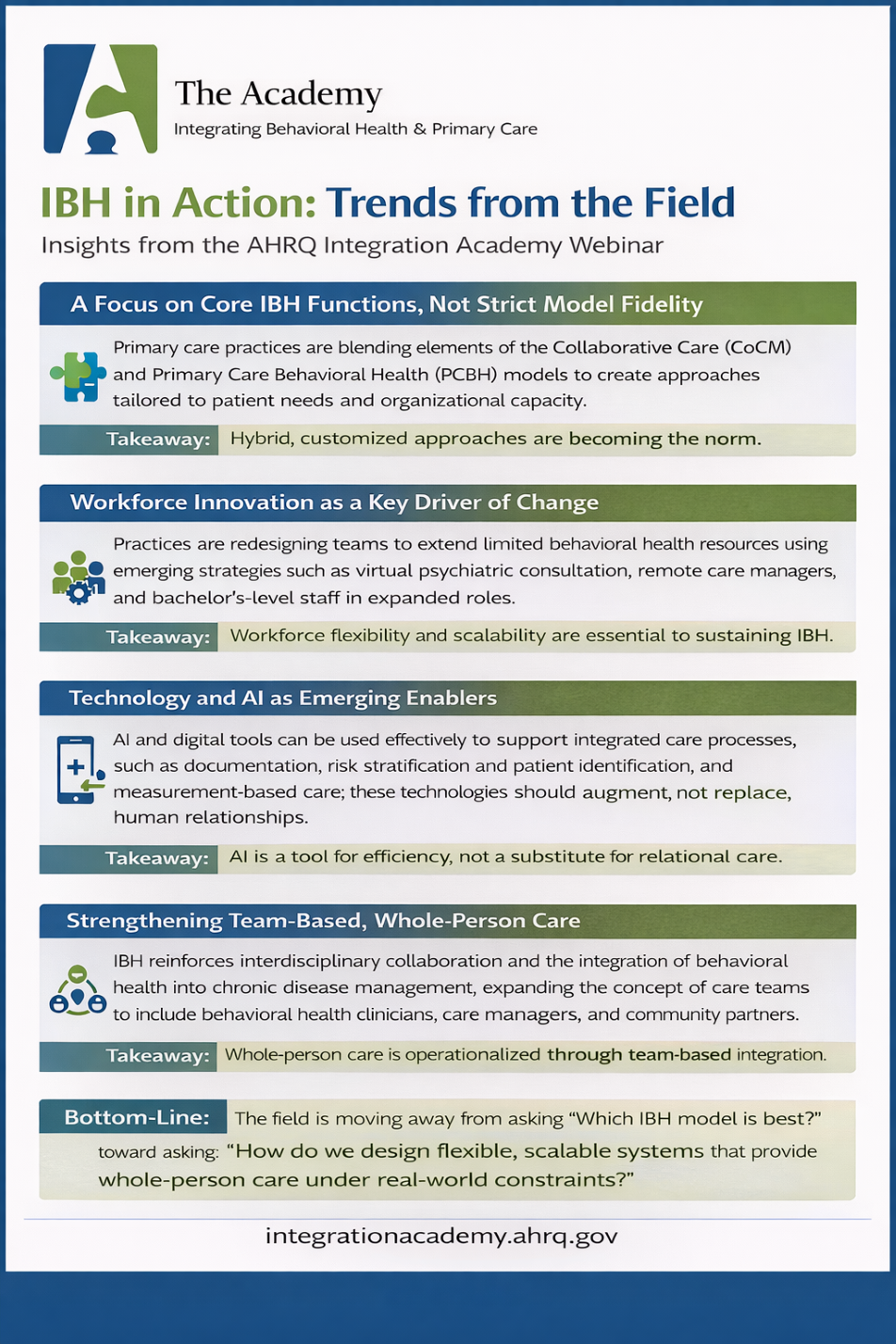
One of the clearest takeaways from the webinar was that integrated behavioral health should not be viewed as a single model or framework. Instead, primary care practices are increasingly drawing from an ecosystem of approaches and thoughtfully combining them in ways that reflect their staffing, patient population, and organizational capacity. Rather than choosing between models such as Collaborative Care (CoCM) or Primary Care Behavioral Health (PCBH), many organizations are blending elements from across models to create a custom approach that meets their unique needs.
As one panelist noted, integration requires flexibility:
“I would challenge all of us to not think about integration as one solution or one approach, but to think about how we layer different types of integrated care approaches depending on the patient needs and the capacity we’re trying to build.”
This perspective reflects a simple reality: no single model can meet the full spectrum of behavioral health needs seen in primary care. In practice, successful integration often looks less like implementing just one framework, but combining approaches in a thoughtful, evidence-based manner to meet specific goals.
Building Behavioral Health Capacity in Primary Care
Another major theme was the importance of strengthening the behavioral health capacity of primary care teams themselves. Primary care clinicians commonly refer patients to specialty behavioral health providers. But, with persistent workforce shortages and long wait times for specialty care, this approach can leave patients without timely support.
Panelists emphasized that integrated care helps address this gap by building primary care teams’ capacity to manage many behavioral health concerns directly within the medical setting. This shift is helping primary care practices respond more effectively to the full range of psychiatric conditions and behavioral health concerns related to chronic disease. It also reflects a broader rethinking of what primary care can and should do to support whole-person health.
Workforce Innovation Driving New Care Models
Workforce constraints continue to shape how integrated care programs are designed and implemented. As demand for behavioral health services grows, many practices are adopting creative strategies to extend the reach of limited clinical resources.
Panelists described emerging workforce innovations such as virtual psychiatric consultations, remote care managers, and expanded roles for bachelor’s-level staff who receive specialized training in integrated care delivery. As a panelist commented:
“We’re seeing teams get really creative about workforce—using virtual psychiatric consultants or bachelor’s-level care managers with the right training to extend the reach of behavioral health services.”
These innovations allow practices to maintain access to behavioral health expertise while building scalable care teams. Together, these approaches illustrate how practices are finding new ways to expand behavioral health capacity despite ongoing workforce constraints.
Adaptation Over Replication
The discussion also underscored that integrated care models are rarely implemented exactly as described in research studies. In real-world settings, practices often need to adapt based on staffing, patient populations, reimbursement structures, and organizational culture. As one panelist put it:
“What we’re seeing in the field is not strict replication of models but thoughtful adaptation to fit the realities of the setting.”
Successful practices, the panelists suggested, are those that maintain the core principles of integrated care, while tailoring implementation to fit their environment. This balance between fidelity and flexibility is increasingly central to sustainable integration.
The Role of AI in Reshaping Integrated Care
Artificial intelligence also emerged as a topic of growing interest among webinar participants.
While still in the early stages of adoption in integrated care settings, panelists noted that AI and other digital tools could soon play an important role in supporting behavioral health integration. Potential applications include streamlining documentation, identifying patients who may benefit from behavioral health services, supporting measurement-based care, and strengthening population health management.
At the same time, speakers emphasized that technology should support, rather than replace, the relational foundation of integrated care. As one panelist noted:
“AI has the potential to help teams work smarter, but it will never replace the human relationships at the heart of integrated care.”
As these tools continue to evolve, they may become another way to extend the reach of primary care teams while preserving the collaborative nature of whole-person care.
Looking Ahead
One message stood out across the conversation: integrated behavioral health is not advancing because primary care practices have found a single “best model.” It is advancing because practices are thoughtfully combining evidence-based approaches to meet their unique needs, in recognition that an ‘all hands-on deck’ approach is required to ensure patients receive the best care.
Across the country, primary care teams are finding creative ways to strengthen behavioral health capacity and better meet patient needs as they move towards the shared goal of delivering more accessible, collaborative, and whole-person care.
Authors
- About Danielle Durant, PhD, MS, MS, MBA
Danielle Durant, PhD, MS, MS, MBA is a Principal Research Associate at Westat, an employee-owned research company, and serves as Lead for Marketing and Promotion for the AHRQ Integration Academy. - About Annaka Paradis, MSc
Annaka Paradis, ScM, is a Lead Research Associate at Westat, an employee-owned research company, and serves as Project Manager for the AHRQ Integration Academy. - About Sara Barker, MPH
Sara Barker, MPH, is Associate Director for Implementation for the AIMS Center at the University of Washington. - About Jeff Reiter, PhD, ABPP
Jeff Reiter, PhD, ABPP, is the founder of Whole Team, PLLC, providing PCBH consulting services, and co-author of three leading “how-to” books on integrated care. - About Neftali Serrano, PsyD
Neftali Serrano, PsyD, is the CEO of the Collaborative Family Healthcare Association.
by Danielle Durant, PhD, MS, MS, MBA; Annaka Paradis, ScM; Sara Barker, MPH; Jeff Reiter, PhD; Neftali Serrano, PsyD